
Ask it yourself, click here: https://ai.ventureintelligence.com
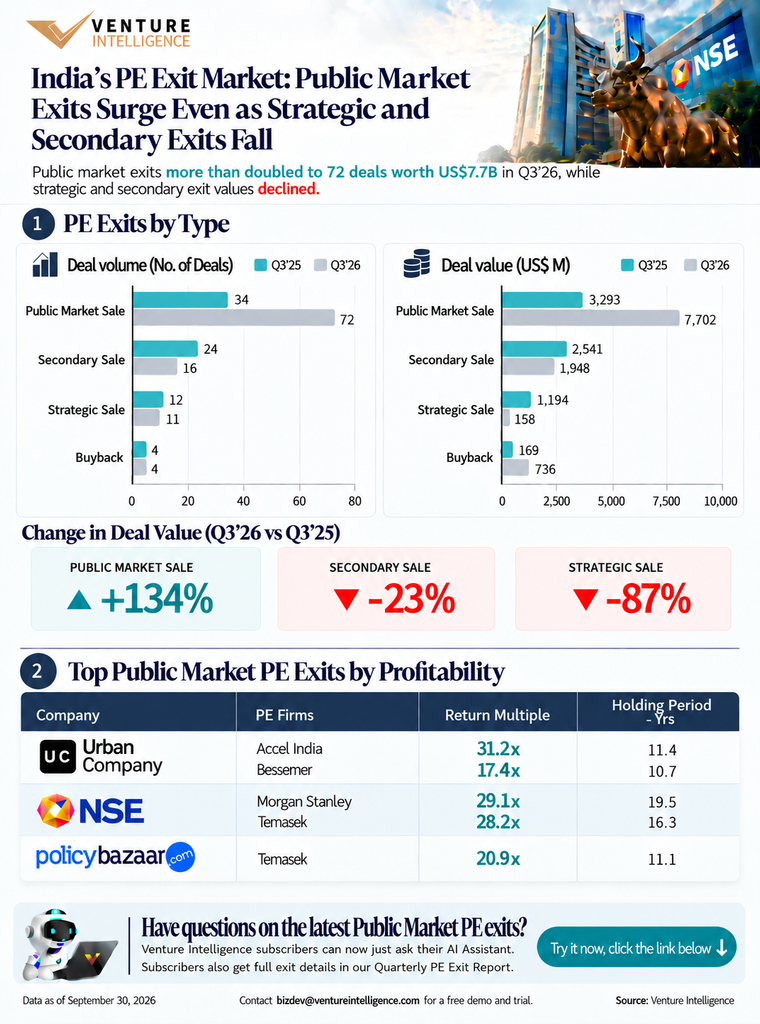
India’s private equity exit landscape is undergoing a permanent structural shift. As private secondary deals and strategic M&A cool down, public markets have emerged as the ultimate liquidity engine for PE and VC funds.
This shift reflects fundamental changes in valuation dynamics, domestic capital flows, and market infrastructure.
📉 Key Realignment Trends & Regulatory Mechanisms
📈 Public Markets vs. Private Disconnect: Strategic acquirers are keeping balance sheets lean, while institutional secondary buyers demand steep valuation discounts. As a result, fund managers are turning to open public markets to protect LP return multiples.
⚡ T+1 & T+0 Settlement Efficiencies: SEBI’s transition to T+1 rolling settlements (and the introduction of the optional T+0 Block Deal framework) allows PE funds to execute multi-hundred-million-dollar trades with minimal price slippage and instant settlement.
💰 Deepening Domestic Liquidity (DII Power): Sustained retail SIP inflows and strong Domestic Institutional Investor buying power mean Indian public markets can easily absorb massive PE block sales from market giants without triggering market crashes.
🤝 Corporate Buybacks as Liquidity Tools: To clear early-stage capitalization tables without waiting for full IPO timelines, companies are increasingly utilizing corporate buybacks to provide fast, flexible exits for early investors.
📌 The Bottom Line
The “Public-First” exit environment proves that Indian stock exchanges are no longer just for raising fresh capital—they are a high-volume, institutional exit engine. PE funds that align their exit strategies with public market depth will continue to lead in delivering returns to global LPs.
Venture Intelligence is India’s longest-serving provider of data and analysis on private company financials, PE/VC transactions, and valuations.
To request a demo or database access, contact: [email protected]
