
Have questions on the Foreign vs. Indian Investor split?
Venture Intelligence subscribers can ask their AI Research Assistant
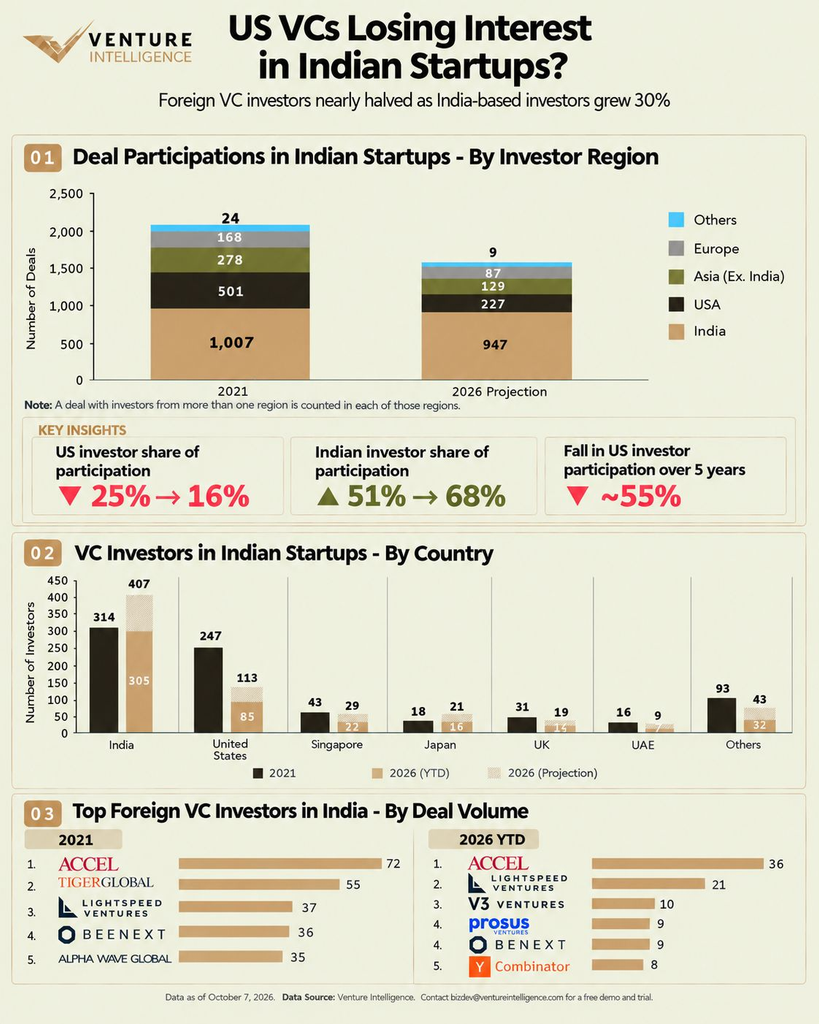
For years, US venture capital firms were the undisputed growth engine for Indian tech startups. However, the market has fundamentally realigned. US VC deal participation in Indian startups has nearly halved—dropping ~55% over a 5-year period and shrinking US market share from 25% down to 16%.
While global mega-funds retreat to defend home portfolios, domestic Indian investors have stepped into the driver’s seat, expanding their share of deal participation from 51% to 68%.
This structural divergence is driven by key policy reforms, tax clarity, and domestic regulatory tailwinds.
⚡ Key Policy Frameworks & Structural Drivers Behind the Shift
- 💸 US Interest Rates vs. Expanding Domestic AIFs: Prolonged elevated interest rates in the US have forced American funds to pull back from cross-border growth bets. Conversely, domestic Indian capital—channeled through rapidly growing domestic Alternative Investment Funds (AIFs)—has stepped in to fill the liquidity gap.
- 🚫 Abolition of “Angel Tax” (Section 56(2)(viib)): The full legislative repeal of Angel Tax across all investor classes eliminated valuation friction and tax scrutiny, unleashing domestic family offices, HNIs, and angel syndicates to back early-stage ventures without tax fear.
- 🏛️ GIFT City (IFSCA Fund Management Framework): Modernized IFSCA fund management regulations allow fund managers to pool domestic and foreign/NRI dollar-denominated capital under streamlined Category I & II AIF structures in GIFT City—avoiding complex offshore jurisdictions like Singapore or Mauritius.
- 💰 Startup India Fund of Funds 2.0 (FFS 2.0) & SIDBI Anchor Capital: Government commitments via SIDBI and credit guarantees (CGSS) continue to provide crucial anchor capital to domestic VC funds, enabling local managers to scale fund sizes and lead larger rounds.
- 📄 Revised DPIIT Startup Recognition Framework: Expanded criteria raising the turnover limit to ₹200 crore (and ₹300 crore for DeepTech ventures) along with extended eligibility windows allow startups to retain tax benefits (Section 80-IAC) longer, giving local VCs confidence to support companies through extended growth phases.
📌 The Bottom Line
The era of relying solely on foreign momentum capital is over. Driven by tax certainty, GIFT City onshoring, and expanding domestic AIF pools, India’s venture capital ecosystem has effectively onshored its funding stack, ensuring local capital drives the next era of Indian innovation.
Venture Intelligence is India’s longest-serving provider of data and analysis on private company financials, PE/VC transactions, and valuations.
To request a demo or database access, contact: [email protected]
